Corporate Governance Code
N/A
Current No. of listed companies
N/A
Exchange
N/A
Listing rules
N/A
Principal legislation
N/A
Public offers / disclosure regulations
N/A
Regulatory body or bodies
N/A
Takeover / merger regulations
N/A
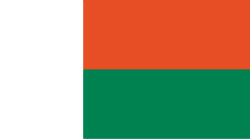
29m
Andry Rajoelina (since 19 January 2019)
Antananarivo
Malagasy ariary (MGA)
Meat processing, seafood, soap, beer, leather, sugar, textiles, glassware, cement, automobile assembly plant, paper, petroleum, tourism, mining
French (official), Malagasy (official), English
Indigenous beliefs 52%, Christian 41%, Muslim 7%
N/A
N/A
N/A
N/A
N/A
N/A
N/A
N/A
26
142
Yes
Yes
No
Yes
Yes
Article 56 of the Decree No. 08-771 dated 28 July 2008 states that it is considered an abusive economic practice when parties to concentration activities hold 30% of local market or reach a pre-tax annual turnover of MGA 10 billion (USD 5 million) on the condition that at least two of the entities totalled a pre-tax annual turnover of MGA 2.5 billion (USD 1.2 million).
Law No. 2018-020 of 28 August 2018 on Competition (Law on Competition) and enforced by Decree No. 08-771 dated 28 July 2008 is the main regulation in force in respect of competition in Madagascar. The Competition Council created by the Law on Competition is the regulatory body, which enforces the Law on Competition. The main responsibilities of the Commission involve:
In decision-making matters:
In advisory matters:
With regard to relations with third parties:
Madagascar is also a Member State of COMESA and therefore subject to the COMESA Competition Regulations.
The provisions of the Law on Competition covers the following points:
Madagascar's local arbitration rules are governed by Law No. 98-019 which came into force on 2 December 1998 and is influenced by the UNCITRAL (UN's Commission on International Trade Law) Model Law. Madagascar is also a party to the New York Convention of 1958 for the recognition and the enforcement of foreign arbitral awards. An independent body, the Centre d'Arbitrage et de Médiation de Madagascar (CAMM) is the arbitration body in charge of the process by which arbitral or mediation disputes are settled. CAMM has its own set of arbitral rules.
The time it takes for a case to be heard depends on the complexity of the case. It will often take between 6 and 24 months to obtain a judgment from the Supreme Court. Cases referred to the Court of Appeal can take longer than 24 months before judgment is obtained.
To be enforceable, foreign arbitral awards must receive an exequatur decision from the Court of Appeal of Antananarivo.
Foreign judgment is enforceable only by virtue of an exequatur decision from the competent court. Upon receipt of an exequatur, a foreign judgment can be enforced in Madagascar.
There are two kinds of magistrates in Madagascar: Magistrates of the seat (magistrats de siège) who have security of tenure; and The Magistrates of public ministry (magistrats du parquet or ministère public) who are subject to the Ministry of Justice.
In practice, public defenders are often unavailable, and there is a vast difference between the representation afforded to rich and poor clients.
The judicial system in Madagascar is organised into two jurisdictions, namely:
The non-permanent jurisdiction includes the High Court of Justice, which is the competent court to try members of the government for crimes or offences committed during their time in office. Another example is the Criminal Court, which is the competent to try all criminal matters. The judgment of the Criminal Court cannot be challenged by applications to Appellate courts; the decision is final.
Permanent jurisdiction: the Supreme Court, the Court of Appeal and the First Instance Court. There is only one Supreme Court in Madagascar which is located in Antananarivo. It is a constitutional court which ensures decisions by lower courts have been taken within the constitutional framework. There are six (6) courts of appeal, which are located in: Antananarivo, Antsiranana, Fianarantsoa, Toamasina, Mahajanga and Toliary. Appeal courts are divided into several jurisdictions: civil chambers, correctional, and social. Madagascar has approximately thirty-nine (39) functional first instance courts.
Law No. 2007-036 dated 14 January 2008 (the Investment Law) relating to investment in Madagascar provides many investments incentives regardless of the nationality of the investor. The Economic Development Board of Madagascar is the main body in charge of the application of the provisions of this Law. There are also many investment incentives in specific industries such as the mining sector. For example, Law No. 2001-031 dated 8 October 2002 amended by Law No. 2005-022 dated 17 October 2005 on Large Mining Investment provides the investor with many specific fiscal and customs benefits under certification of the investment plan by the Government of Madagascar - any investment must exceed MGA 50.000.000.000 (approx. 12 million USD) to qualify for these benefits.
The provisions of the Investment Law covers the following points:
N/A
Some of the key legislation governing communications and broadcasting is set out below:
Order No. 14.762 / 2012 on packaging and labelling; and Order no. 13674/2017 Modifying and supplementing certain provisions of interministerial order n°31 701/2015-MSANP dated 16 October 2015 with a view to determining the new markings and labeling on all packaging for tobacco products on sale in Madagascar. and
Order no. 18171/2003 dated 22 October 2003 regulating the industrialisation, importation, the marketing of tobacco and of tobacco consumption.
Gains derived from the sale of real property or real property interests are subject to a 20% tax. This is included in the corporation tax calculation.
20% for local and foreign companies resident and registered in Madagascar, regardless of the nationality of the shareholders or where they are managed or controlled. A Company may carry on a trade or business outside Madagascar - companies are not restricted to Madagascar. Corporations in specific industries such as those elected to free zone trade (as regulated byDecree no. 2005-087 amending certain provisions of decree no. 92-809 of 9 September 1992 implementing law no. 89-027 of 29 December 1989 relating to the industrial free zone regime in Madagascar, as amended and supplemented by law no. 91-020 of 12 August 1991) do not have to pay many taxes or customs commitments. A company which elects to the Large Mining Investment Framework (a framework to encourage mining) is entitled amongst other benefits, to the stability of its due taxes during a period of 25 years.
Dividends paid to a resident or non-resident are not taxed in Madagascar.
Current operations from Madagascar to another jurisdiction are free but are required to be made through an authorised bank. Transfer of capital out of Madagascar requires the prior consent of the Ministry in charge of Finance.
Corporations elected to the Free Trade Zone are entitled to:
Interest paid to a non-resident is subject to 20% withholding tax.
Tax losses cannot be carried forward in Madagascar. However, in the mining industry when regulated under the Large Mining Investment Framework, losses, explorations costs and financial reductions resulting from investment can be amortized up to a total of 50%.
Tax is withheld by an employer on a monthly basis at graduated rates up to 20% in respect of the monthly wages. 14% Social Security: 13% contribution of the employer; 1% contribution from the employee. The social security in Madagascar includes two bodies: the mandatory social security fund (CNAPS); and the worker health organisation (OSTIE). The social security system covers all people employed in Madagascar. Employers with employees performing services in Madagascar must register with these organisations.
Resident individuals are taxed on worldwide income at the rate of 20%. Non-resident individuals are liable to tax only on Madagascar-source income.
An annual building tax is imposed on the owner of a building at rates varying from 5% to 10%. Transfer of ownership of commercial business gives rise to the payment of tax at the rate of 6%.
Royalties paid to a resident or a non-resident are subject to 5% withholding tax.
0.5% Applies on corporation capital gains, mergers and transfer of shares.
N/A
Madagascar does not have a specific law governing thin capitalisation, but interest expense may be disallowed where it arises on shareholder loans in excess of fixed capital.
Profit transfers included in payments between resident corporations and non-resident affiliates may be adjusted.
20% standard rate
John W Ffooks & Co
Address: John W Ffooks & Co
Madagascar - Head Office
Immeuble Assist - 1st Floor
Ivandry
Antananarivo
101 Madagascar
Tel: (+261) 20 224 3247
Fax: (+261) 20 224 3248
John W Ffooks & Co was established in 2005 and remains the largest independent full service commercial law firm in Francophone Africa. Since then JWF has grown exponentially both in terms of size and its service offering – the firm now boasts over 40 lawyers each of whom are qualified to advise in their home jurisdiction, as well as office locations in Togo, Guinea, Madagascar, Mauritius and Senegal. The main areas of focus of the firm are: Corporate, Commercial, Energy, Projects, Natural Resources, Banking & Finance and Telecommunications.
John Ffooks, the founding partner of the firm, first came to Madagascar in 2002 and has over 25 years experience acting for listed companies in Australia, London, New York and Toronto with assets across Africa. Before setting up the firm in 2005 John worked for Clifford Chance LLP and LeBoeuf, Lamb, Greene & McRae LLP in London as well as spending some time at the Development Bank of South Africa in Johannesburg. John is now based in London but has lived and worked as a lawyer in Africa for over 20 years.

Find out how Addleshaw Goddard can support you to navigate through the legal challenges when doing business in the African markets.