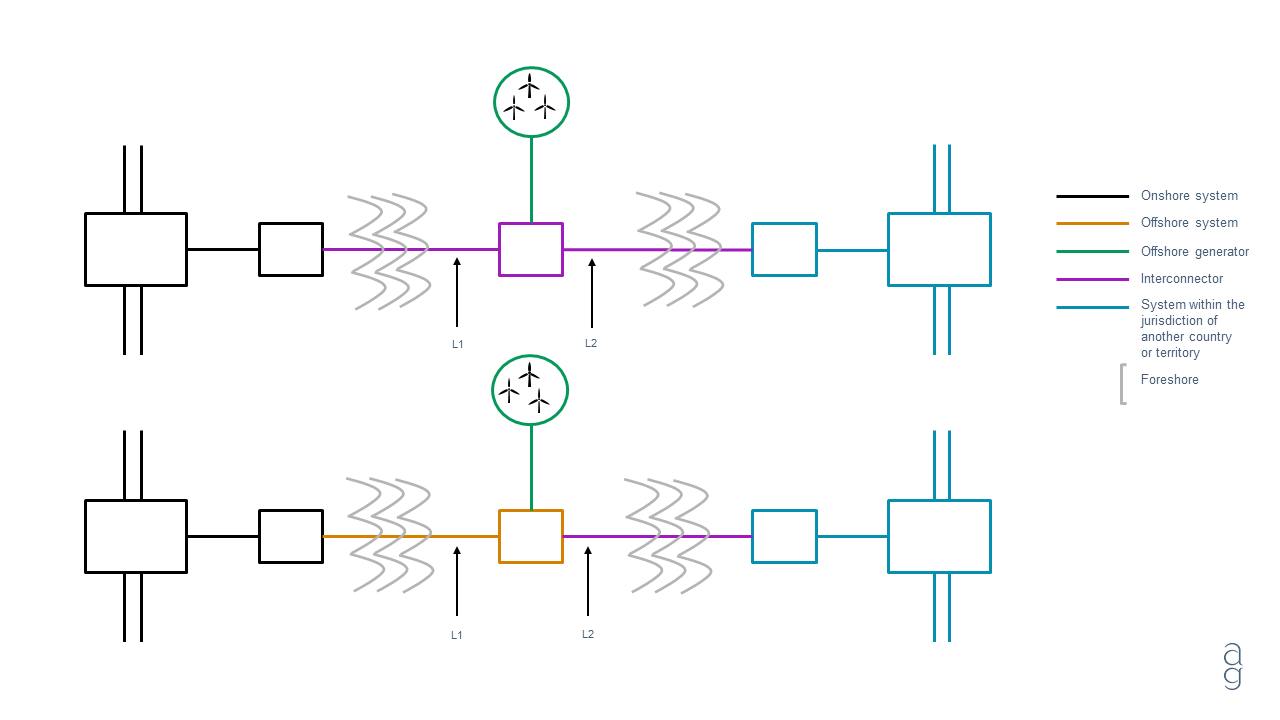
The cross-border nature of MPIs means that the domestic rules that govern them must be compatible with the rules of the connecting jurisdictions, including the EU.
A key concern is the relationship between the choice of market model - Home Market (HM) or Offshore Bidding Zone (OBZ) - and the requirement under Article 16(8) of Regulation (EU) 2019/943 (the Electricity Regulation) that at least 70% of interconnection capacity must be available for cross-border trade (the 70% requirement).
The HM, where the OWF forms part of its “home” bidding zone, is not compatible with the 70% requirement and would likely require derogations from the Article, but the OBZ, which contemplates a separate bidding zone containing one or more OWFs, does not present this dilemma since generation capacity sent to ether connecting market is considered cross-zonal. For this reason, OBZ is the European Commission’s preferred solution.
However, under the OBZ approach, OWFs would earn less revenue, which may discourage investment. This is because, under the HM, the OWF will receive the price of the “home” bidding zone, but under the OBZ the OWF receives the price of the exporting zone, which is lower.
Following the UK’s exit from the EU, the “70% requirement” has been removed from domestic law. The Trade and Cooperation Agreement (TCA), which now governs cross-border electricity trading between GB and the EU, requires the maximum level of capacity of interconnectors to be made available, respecting the need to ensure secure system operation and most efficient use of systems.
Ofgem will work with parties involved in the development of new cross-border trading arrangements pursuant to the TCA to identify the best way forward.
An important factor in the efficient use of MPIs is the use of implicit trading, where the capacity on the interconnector and the energy product are bought together, as opposed to explicit trading, where the capacity and the energy are traded separately.
Although technically, both HM and OBZ models could support both implicit and explicit trading, Ofgem’s view is that explicit trading is less efficient. It will continue engagement with the relevant bodies to support discussions in this space.
Another point of concern is the interactions between priority dispatch and curtailment in the different market models and the relationship between curtailment of interconnectors and the future cross-border trading arrangements under the TCA. In GB, new renewable generators cannot benefit from priority dispatch (Article 12 of the retained Electricity Regulation); and renewable generators may be curtailed only as a last resort (Article 13).
Ofgem will consider potential interactions between the two market models and whether there may be any possibility of a transition from one model to another. It will engage with industry to better understand the available solutions to further inform its thinking on the most appropriate arrangement for early opportunity projects.
The consultation closes on 9 June 2022.